import { serializeError } from 'serialize-error'
import WDIORepl from '@wdio/repl'
import { environment } from '../../environment.js'
*
* This command helps you to debug your integration tests. It stops the running browser and gives
* you time to jump into it and check the state of your application (e.g. using dev tools).
* Your terminal transforms into a [REPL](https://en.wikipedia.org/wiki/Read%E2%80%93eval%E2%80%93print_loop)
* interface that will allow you to try out certain commands, find elements and test actions on
* them.
*
* [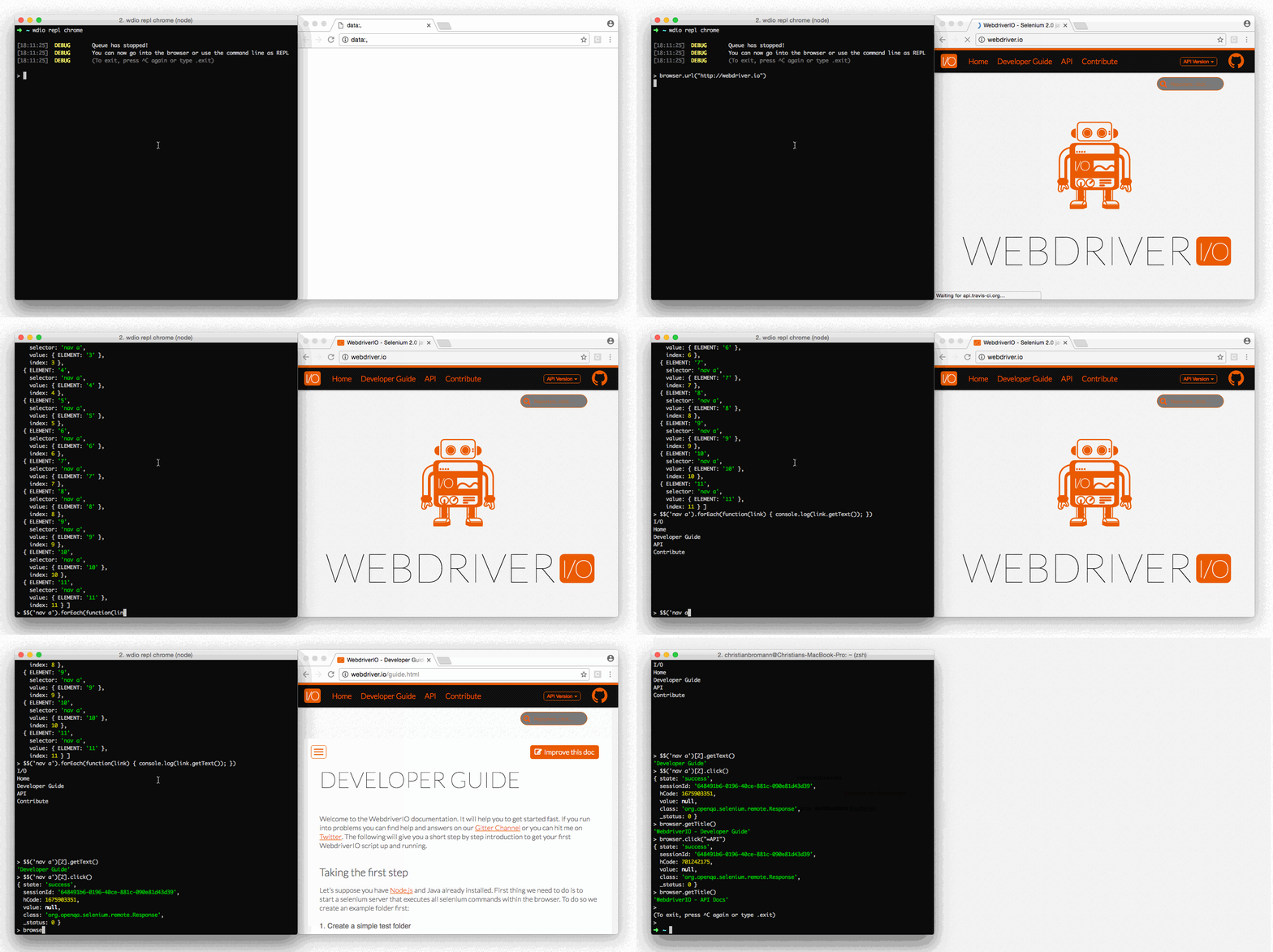](https://webdriver.io/img/repl.gif)
*
* If you run the WDIO testrunner make sure you increase the timeout property of the test framework
* you are using (e.g. Mocha or Jasmine) in order to prevent test termination due to a test timeout.
* Also avoid executing the command with multiple capabilities running at the same time.
*
* <iframe width="560" height="315" src="https://www.youtube.com/embed/xWwP-3B_YyE" frameborder="0" allowFullScreen></iframe>
*
* <example>
:debug.js
it('should demonstrate the debug command', async () => {
await $('#input').setValue('FOO')
await browser.debug() // jumping into the browser and change value of #input to 'BAR'
const value = await $('#input').getValue()
console.log(value) // outputs: "BAR"
})
* </example>
*
* @alias browser.debug
* @type utility
*
*/
export function debug(
this: WebdriverIO.Browser,
commandTimeout = 5000
): Promise<void | unknown> {
const repl = new WDIORepl()
const { introMessage } = WDIORepl
const process = globalThis.process as NodeJS.Process
* run repl in standalone mode
*/
if (!environment.value.variables.WDIO_WORKER_ID || typeof process.send !== 'function') {
console.log(WDIORepl.introMessage)
const context = {
browser: this,
driver: this,
$: this.$.bind(this),
$$: this.$$.bind(this)
}
return repl.start(context)
}
* register worker process as debugger target
*/
process._debugProcess(process.pid)
* initialize repl in testrunner
*/
process.send({
origin: 'debugger',
name: 'start',
params: { commandTimeout, introMessage }
})
let commandResolve = () => { }
process.on('message', (m: { name: string, origin: string, content: { cmd: string } }) => {
if (m.origin !== 'debugger') {
return
}
if (m.name === 'stop') {
process._debugEnd(process.pid)
return commandResolve()
}
if (m.name === 'eval') {
repl.eval(m.content.cmd, global, undefined, (err: Error | null, result: unknown) => {
if (typeof process.send !== 'function') {
return
}
if (err) {
process.send({
origin: 'debugger',
name: 'result',
params: {
error: true,
...serializeError(err)
}
})
}
* try to do some smart serializations
*/
if (typeof result === 'function') {
result = `[Function: ${result.name}]`
}
process.send({
origin: 'debugger',
name: 'result',
params: { result }
})
})
}
})
return new Promise<void>((resolve) => (commandResolve = resolve))
}


